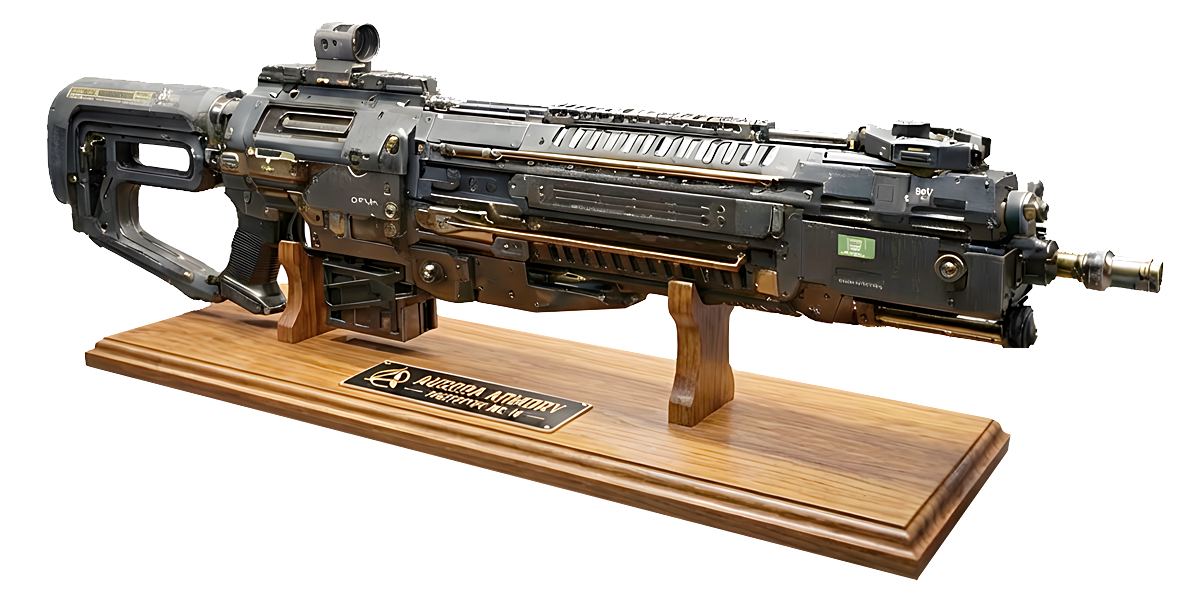
HMR‑9 “Peregrine”
The HMR‑9 “Peregrine” is the standard squad‑level shield‑piercing rifle, designed to:
- Engage personal bubbles, light and heavy.
- Defeat vehicle and walker screens.
- Drill into static perimeter fields, including adaptive and “amnesia” shields.
The rifle and its Type‑VI mags form a closed learning loop that adapts to local shield behavior while resisting hostile feedback and data‑poisoning.
Know what you’re holding before you pull the trigger.
- Caliber: Bore‑shaped phased plasma slug; morphable geometry (bolt / drill / spear).
- Effective bore range: ~600 m line‑of‑sight under standard conditions.
- Trigger half‑press: emits low‑energy field sniff pulse.
- HUD feedback: rifle reports its trust state as: CALM, SKEPTICAL, LOCKED.
- Magazine type: Type‑VI Hardened Learning Mag (“Vee‑Six”). Brass‑ribbed, status window on side.
Use this whenever you have time to let the mag learn.
- Identify fielded target.
Confirm visual/thermal shield: domes, shimmer, or sensor flag. - Sniff the shield.
Half‑press trigger until HUD shows FIELD LOCKING… then LOCKED.
Do not spam sniff pulses. One clean read beats five dirty ones. - First shot: mapping round.
Fire one BLUE bore shot. Watch shield flare and penetration indicator (if present). - Second & third shots: learning phase.
Fire controlled singles or short bursts, adjust aim point slightly. Let the mag refine its model. - If no improvement after 3–4 hits, or HUD goes LOCKED:
Call “Amnesia dome, Peregrine locked.” and shift to heavy support / alternate breach.
Treat Vee‑Six mags as experienced kit, not disposable sticks.
- Label your mags. Mark by theatre or shield type (e.g., URB‑GRID‑1, FLEET‑HULL).
- Do not toss siege‑trained mags back into general ammo pools.
- If HUD shows MAG SUSPECT, finish contact if needed, then quarantine.
- Report lost Vee‑Six mags. Treat as classified hardware.
Built to learn fast, then refuse corrupted lessons.
- Physical build: brass‑ribbed shell, shielded body, side status window.
- Internal memory:
- Fast cache & shadow cache (dual live copies).
- Golden store (last known‑good profile, radiation‑hardened).
- Error correction: all models and telemetry use ECC; bad packets are discarded.
- Telemetry security: fired rounds sign their reports; mags ignore unauthenticated “ghost data.”
Red does not mean “empty.” It means the mag refuses new shield lessons. You still have bore shots; they just won’t adapt.
- CALM (Green): clean telemetry, penetration improving.
Action: use BLUE bore mode as normal. Avoid unnecessary mag swaps mid‑learning. - SKEPTICAL (Amber): inconsistent data or slow improvement.
Action: fire fewer, better‑aimed shots; report to squad lead that the Peregrine is “skeptical.” - LOCKED (Red): suspected amnesia or hostile shield feedback.
Action: stop expecting adaptation. Rifle auto‑uses BLUE‑HARD safe profile. Call for heavy support / alternate breach.
Standard bolt. Unshaped plasma for soft, unshielded targets. Use to conserve mag learning capacity for when shields appear.
Bore mode. Shaped, drilling plasma that learns from each hit unless HUD is LOCKED. Default vs any visible field.
Locked bore profile. Engages under suspected amnesia or severe noise. Less efficient, more trustworthy. Auto‑selected when Peregrine locks.
- Symptom: No FIELD LOCKING… even with visible shield.
Check: optic alignment, muzzle apertures for fouling. Switch to BLUE‑HARD and report after contact. - Symptom: HUD flipping rapidly between CALM and SKEPTICAL.
Likely: adaptive or “drunken” shield.
Action: shorten bursts, stagger shots; coordinate with squad for multi‑angle probing. - Symptom: Sudden drop from CALM to LOCKED after a weird hit.
Likely: amnesia spike / data‑poison attempt.
Action: trust the lock, don’t attempt to “force” learning back. Escalate.
The Peregrine runs two internal “minds”: an open, fast learner and a slow, paranoid survivor. Under clean conditions, the fast learner guides bore shaping. Under hostile conditions, the survivor takes over and refuses to accept bad lessons.
- Once the rifle locks, no squad‑level action can “talk it out of it” mid‑fight.
- Do not treat CALM as permanent; shields adapt and lie back.
- Respect the lock state; it’s there to protect your mag’s memory from corruption.